LGBT people in Bangladesh face violence in the “private” sphere—by members of immediate and extended family, community and religious groups. Homosexuality is often looked upon as a sin in Bangladesh. Gay men who inform their families about their sexual orientation are forced into a heterosexual marriage and still Parents consider homosexuality as a mental illness.
Good morning to all of you.
I would like to take the privilege to express my sincere thanks to all of you for the opportunity to present in this conference.
It is my honour to be here with all of you, who have been working for human dignity, where all citizens of the world including ethnic and sexual minority community will enjoy justice and fundamental rights.
Ladies and gentleman
I would like to focus my speech today on ethnic and sexual minorities on Bnagladesh who are most disadvantaged, vulnerable and deprived groups in many aspects of economic, social, cultural and political rights due to their status of ethnic and sexual minority. They are the main victims of violation of human rights facing to widespread violence and discrimination, including forced eviction, land grabbing, killings, rape, physical and sexual assaults and the perpetrators of the violence benefit from complete.
Ladies and gentlemen
There are minimum 3 million indigenous people belonging 45 communities living in around 54 distinct in Bangladesh and also approximately 3 million LGBT community people living all over the country. Unfortunately the Constitution of Bangladesh does not recognize the identity and rights of the ethnic and sexual minority people properly. Denial of fundamental rights and identity of indigenous and LGBT peoples in the newly 15th amended of Constitution has disappointed peoples of Bangladesh. Because we thought that as a human being the present more liberal Bangladesh Awami League led grant alliance government will recognize them properly.
Now I would like to specifically tell something about indigenous people in Bangladesh. The indigenous peoples living in Chittagong Hill Tracts Area and also the plain land area in rest of the country have been facing problems with their land and economy for centuries. Most of the indigenous peoples are living on their traditional ancestral land. But It is regretful that the government claims that those are governments land and the traditional land rights of indigenous peoples are being ignored in Bangladesh. They have continuously been targeted to aggression, attack and eviction from their ancestral land. These resulted their marginalization and elimination.
Ladies and gentlemen
In this year I have been investigated the brutal incident of communal arson attacked on the Jumma people in Chittagong Hill tracts area in the month of February and also in the month of April. During the investigation I have seen how the indigenous peoples were victimized by the Bengali settler in presence of law enforcing agencies including army and Border Guard of Bangladesh. We saw that the Bengali settler people set fire on the house of Indigenous people in Rangamati district and also the Khagrachhari district in Chittagong Halftracks reason spreading the communal tension resulted more than hundred and twenty houses were burn to ashes. They Bengali people were also looted the valuable movable properties of them. Both of the time of attacked the Army men and Boarder Guard of Bangladesh were present. But they were nothing do to prevent those atrocities; rather the Bengali people were done their destruction more intensively in presence of law enforcing agencies. Yet the Indigenous victims were not get the justice connecting both of those incident. Rather one victim was facing continuously threats of death to withdraw the allegation, who were filed an case connecting those incident.
I am the first people as well as the organization who conduct the fact was finding investigation visiting the spot. During the time of my investigation, the border guard of Bangladesh (BGB) and also the District Special Branch of Police expressed strong suspicion towards any international involvement in connecting those incidents of communal attract. I was also approached and questioned on multiple occasions by members of the Border Guards of Bangladesh and by the district special branch of police. The policemen took me and my investigation team to one corner of the field in front of the police station. Sitting on the ground, he asked similar questions repeatedly for 3 hours creating a scaring atmosphere.
Ladies and gentlemen
I was also investigated the incident of brutal torture on jumma student during peaceful demonstration demanding constitutional reorganization in the moth of August of this year at Khagrachhari district of Chittagong Halftracks. I saw that the policemen were attacked on the peaceful student demonstration with direct command of additional superintend of police resulting 22 student were injured including five girls student. The indigenous jumma student were not only victim of torture, but also threaded to spoil their future carrier by the additional deputy commissioner if they further try to participate any demonstration in near future. They also denied getting treatment from the hospital as the army men were patrolling in front of hospital. During my investigation I was continuously followed by the civil dressed member of law enforcing agencies. These types of violation against ethnic minority people are common and widespread in Bangladesh.
Ladies and gentlemen
Bangladesh government has ratified the ILO Convention No. 107 on indigenous and tribal populations where ensure the traditional land rights of indigenous people. But they are not willing to implementation this Convention.
Since 14 years passed of signing of Chittagong Hill Tract peace accord, but it is so painful to say that most of the main issues of the Accord have not been implemented by the government. Even yet the government has not declared a time-framed ‘Road Map’ directing to implementation of the CHT Accord, 1997.
Ladies and gentlemen
Now I would like to speak a little bit about present situation of the sexual minority community people in Bangladesh. There are approximately 3 million lesbian, Gay, Bisexual and Transgender community people living all over the country. But they are facing a lot of cultural, social, religious, and legal impediment.
They are livings in society hiding their identity. If discovered their sexual orientation, they often pay a high social price including expelled from educational institution, their jobs and also from the inheritance from their family.
I began my activities to establish the rights of the LGBT community people to discussing and sharing about their existing social, economical, institutional as well as legal problems. I also began to aware them about their rights as a human being and also motivating them to stand under one umbrella, so that they can rise their voice strongly. I saw how they are discriminating in the family, social, educational institution and workplace because of their gender and sexual orientation.
Especially, Transgender/gender people are marginalized in their jobs, and are targeted for blackmail, harassment, and sexual violence from the community or people in positions of authority like the police. They also tortured and sexual harassed by Law enforcing agencies.
Frequently, LGBT people in Bangladesh face violence in the “private” sphere—by members of immediate and extended family, community and religious groups. Homosexuality is often looked upon as a sin in Bangladesh. Gay men who inform their families about their sexual orientation are forced into a heterosexual marriage and still Parents consider homosexuality as a mental illness.
The status of homosexuality as a social and religious taboo is also reflected in the Bangladeshi Criminal Code. Its Section 377, a legacy of British rule, refers to consensual oral and anal sex as “carnal intercourse against the order of nature” and subjects it to punishment up to imprisonment for life. Effectively, this section makes homosexual intercourse illegal in Bangladesh. Crucially, Bangladesh was one of the opposing countries to the recent 2010 UN Declaration proclaiming the rights of LGBT communities.
Human rights activist who defend rights of the ethnic, religious and sexual minority people are subjected to threats to their safety, including death threats, physical attacks, assault and harassment, arbitrary arrest even torture and abuse with police participating in or doing nothing to stop these violations as a result of their work. They also face problem of non cooperation from the sate to provide enough information and inherited freedom of activities
There is a NHRC commission Bangladesh which has been established in 2007. But the commission is like a toothless tiger due to control over by the government.
Ladies and gentlemen
The ethnic and sexual minority Peoples of Bangladesh at present are face to face with the following challenges, such as–
· Absence of democratic and secular rules in the country;
· There is no adequate policy to protect the land of indigenous peoples.
· The International Laws, such as, ILO Convention No. 107 and 169 are ignored;
· The traditional land rights of the indigenous peoples are denied;
· Lacking of acceptance of LGBT community people in their family, society and state;
· Socially stigmatization and Lack of acceptance of 2010 UN Declaration proclaiming the rights of LGBT communities by the state.
· Lack of expression of the individual desire, compulsory marriage, and lack of visibility of sexual minority issues.
Under the existing circumstances of the country, I would like to appeal to the international community, particularly European Union democratic for this kind consideration on the following recommendations-
Engage in dialogue with GoB to
· Expedite the full, speedy and effective implementation process of CHT Accord, 1997;
· Enhancement of national and international efforts directing to protect and preserve the entity and rights of the ethnic and sexual minority peoples trough supporting the NGO’ and Civil Societies organizations;
· Special drive for the restoration of the traditional land and establish rights to land of the indigenous peoples;
· Decriminalize the Section 377 Penal Code on the decriminalization of homosexual acts
· Implementation of the UN declaration of the rights to indigenous people and UN Declaration proclaiming the rights of LGBT communities as well as ratifying the ILO Convention No. 169, 107 ;
· To take initiative to establish effective NHRC free from the control of government.
We also urge the EU to take initiative to ensure the protection and freedom of activities of human rights defender who are directly and indirectly involve with upholding the rights of ethnic and sexual minority people of Bangladesh through intergovernmental dialogue and also ensuring financial, psychological and physical integrity of persecuted human rights defender through direct support.
Before concluding, I would like to express my thanks and gratitude to the Global Human Rights Defence giving me opportunity to rise up the voice of ethnic and sexual minority community in Bangladesh and also to the Swedish MEP Cecilia Wikström, (Folkpartiet – Swedish liberal party) for hosting this important conference on protecting minority rights in South Asia.
Thanking you all.
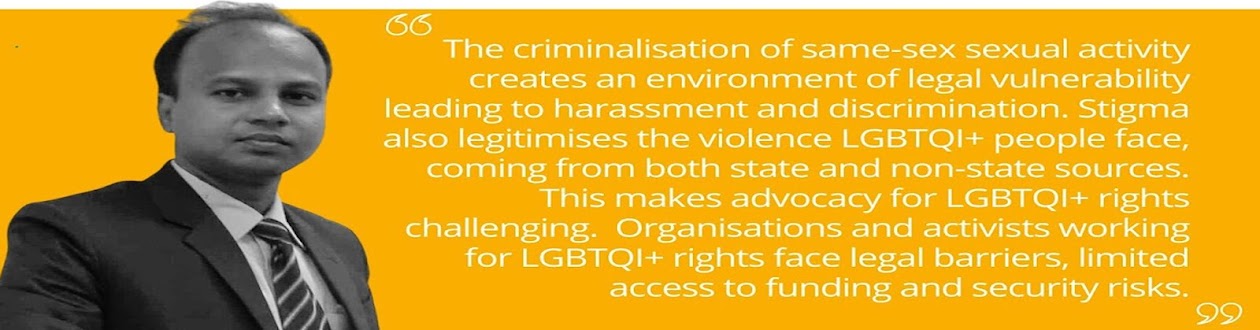
 Bangladeshi prominent human rights lawyer Shahanur Islam participated as a discussant in the International Symposium titled "Safer-to-Be-Me" held at Sunderland University in England. The symposium was jointly organized on June 22 by the England-based international human rights organization Report Out International and the University of Sunderland.


 Amongst the speakers were Taslima Nasreen, Bangladeshi writer in exile, winner of the European Parliament Sakharov Prize 1994; Anuradha Koirala (photo to the left), awarded CNN Hero 2010 for her impressive work against human trafficking in Nepal –
  The manifesto also concludes that it remains too difficult for civil society and local human rights organizations in South Asia to access the EU institutions and calls for actions to bridge the gap between human rights defenders on the ground and the EU institutions.


 Advocate Shahanur Islam, Founder of JusticeMakers Bangladesh was attend the hearing along with other representives from Bangladesh Minority Watch, JusticeMakers Bangladesh, Human Rights Focus Pakistan, Hindu American Foundation Maiti Nepal and Bhutanese Advocacy Forum and also spoke on human rights issues in their home countries, with specific focus on minority rights, trafficking, ethnic & sexual minorities, poverty, and Dalit issues.


